
The short answer
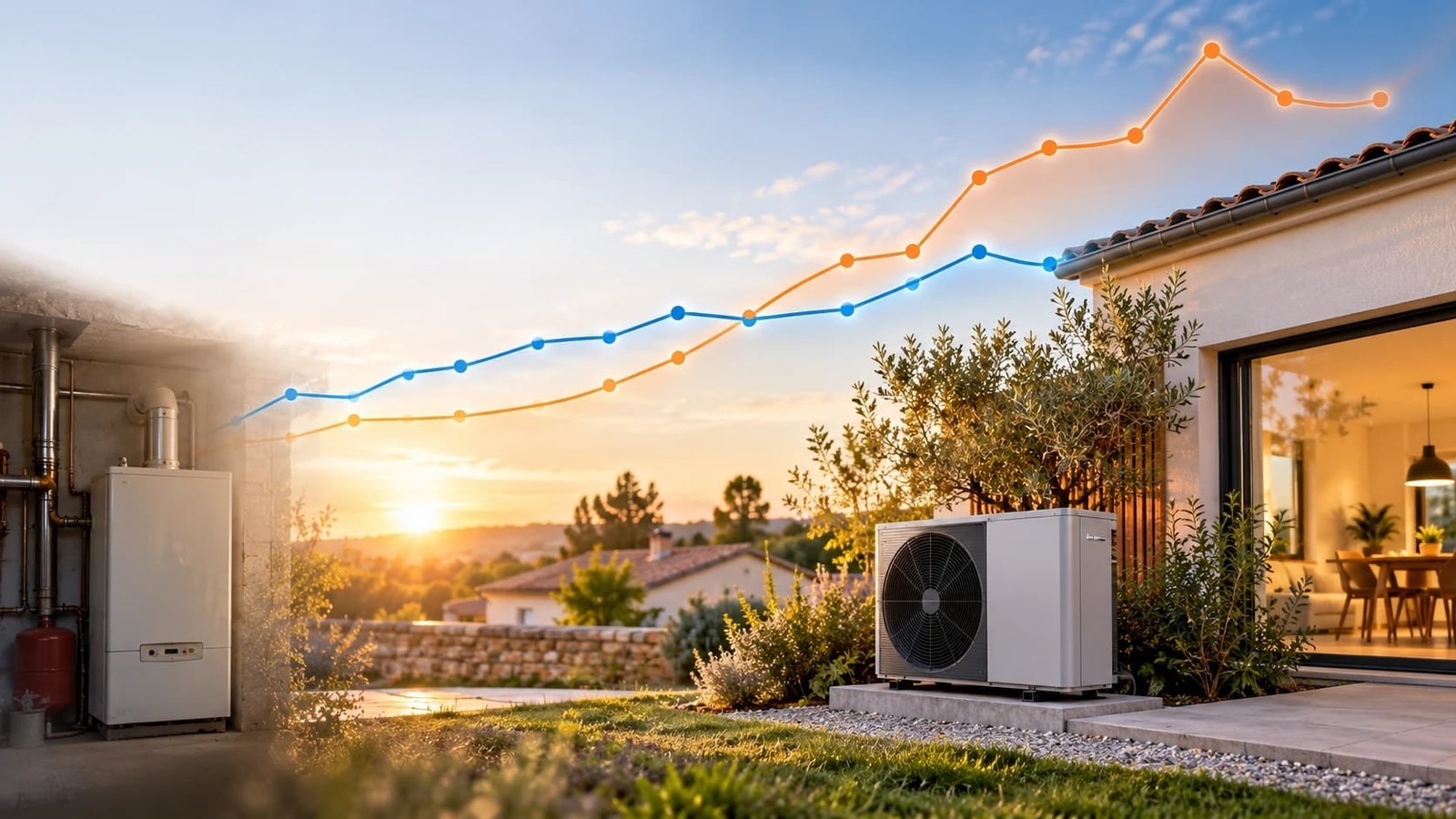
Between October 2020 and October 2026, the price of a kWh of gas for heating in France was multiplied by 2.9 (+188%), while electricity rose by 29%. As a result, heat from a heat pump now costs much less than heat from a gas boiler, whereas the gap was small in 2020.
Is it worth it for you? It depends mainly on how much heat your home needs, the water temperature your radiators require and the price of the installation after grants. The simulator below gives you an order of magnitude with your own figures.
How prices have changed since 2020
How the price of a kWh has changed in France
Prices including taxes in force in October of each year, excluding the standing charge. Gas: heating use; electricity: regulated tariff, Base option.
From October 2020 to October 2026
- Heating gas
- +188%
- 5.1c → 14.6c per kWh
- Electricity
- +29%
- 15.6c → 20.0c per kWh
In October 2020, a kWh of electricity cost 3.1 times a kWh of gas; in October 2026, only 1.4 times.
Hover over a point to read that year's prices; click the legend to hide a line.Tap the chart to read that year's prices; tap the legend to hide a line. Choose at least one line.
Gas: regulated tariff in 2020, 2021 and 2022 (frozen by the tariff shield in 2021 and 2022), then the benchmark price of the Energy Regulatory Commission (CRE), as the regulated tariff ended on 30 June 2023. Electricity: regulated tariff. Sources: CRE; data checked on 23 October 2026.
See all prices, month by month
| Month | Gas (€/kWh) | Electricity (€/kWh) |
|---|---|---|
| January 2020 | 0.0568 | 0.1524 |
| February 2020 | 0.0547 | 0.1546 |
| March 2020 | 0.0518 | 0.1546 |
| April 2020 | 0.0491 | 0.1546 |
| May 2020 | 0.0484 | 0.1546 |
| June 2020 | 0.0469 | 0.1546 |
| July 2020 | 0.0469 | 0.1546 |
| August 2020 | 0.0476 | 0.1557 |
| September 2020 | 0.0479 | 0.1557 |
| October 2020 | 0.0506 | 0.1557 |
| November 2020 | 0.0515 | 0.1557 |
| December 2020 | 0.0530 | 0.1557 |
| January 2021 | 0.0531 | 0.1557 |
| February 2021 | 0.0552 | 0.1582 |
| March 2021 | 0.0588 | 0.1582 |
| April 2021 | 0.0561 | 0.1582 |
| May 2021 | 0.0568 | 0.1582 |
| June 2021 | 0.0597 | 0.1582 |
| July 2021 | 0.0664 | 0.1582 |
| August 2021 | 0.0704 | 0.1558 |
| September 2021 | 0.0772 | 0.1558 |
| October 2021 | 0.0891 | 0.1558 |
| November 2021 | 0.0891 | 0.1558 |
| December 2021 | 0.0891 | 0.1558 |
| January 2022 | 0.0891 | 0.1558 |
| February 2022 | 0.0891 | 0.1740 |
| March 2022 | 0.0891 | 0.1740 |
| April 2022 | 0.0891 | 0.1740 |
| May 2022 | 0.0891 | 0.1740 |
| June 2022 | 0.0891 | 0.1740 |
| July 2022 | 0.0891 | 0.1740 |
| August 2022 | 0.0891 | 0.1740 |
| September 2022 | 0.0891 | 0.1740 |
| October 2022 | 0.0891 | 0.1740 |
| November 2022 | 0.0891 | 0.1740 |
| December 2022 | 0.0891 | 0.1740 |
| January 2023 | 0.1053 | 0.1740 |
| February 2023 | 0.1053 | 0.2062 |
| March 2023 | 0.1053 | 0.2062 |
| April 2023 | 0.1053 | 0.2062 |
| May 2023 | 0.1053 | 0.2062 |
| June 2023 | 0.1053 | 0.2062 |
| July 2023 | 0.0820 benchmark price | 0.2062 |
| August 2023 | 0.0841 | 0.2276 |
| September 2023 | 0.0822 | 0.2276 |
| October 2023 | 0.0932 | 0.2276 |
| November 2023 | 0.0978 | 0.2276 |
| December 2023 | 0.1041 | 0.2276 |
| January 2024 | 0.1095 | 0.2276 |
| February 2024 | 0.0985 | 0.2516 |
| March 2024 | 0.0929 | 0.2516 |
| April 2024 | 0.0879 | 0.2516 |
| May 2024 | 0.0894 | 0.2516 |
| June 2024 | 0.0914 | 0.2516 |
| July 2024 | 0.1026 | 0.2516 |
| August 2024 | 0.1050 | 0.2516 |
| September 2024 | 0.1036 | 0.2516 |
| October 2024 | 0.1106 | 0.2516 |
| November 2024 | 0.1093 | 0.2516 |
| December 2024 | 0.1124 | 0.2516 |
| January 2025 | 0.1185 | 0.2516 |
| February 2025 | 0.1188 | 0.2016 |
| March 2025 | 0.1214 | 0.2016 |
| April 2025 | 0.1241 | 0.2016 |
| May 2025 | 0.1162 | 0.2016 |
| June 2025 | 0.1100 | 0.2016 |
| July 2025 | 0.1085 | 0.2016 |
| August 2025 | 0.1080 | 0.1952 |
| September 2025 | 0.1054 | 0.1952 |
| October 2025 | 0.1034 | 0.1952 |
| November 2025 | 0.1035 | 0.1952 |
| December 2025 | 0.1028 | 0.1952 |
| January 2026 | 0.1019 | 0.1952 |
| February 2026 | 0.0998 | 0.1940 |
| March 2026 | 0.1051 | 0.1940 |
| April 2026 | 0.1042 | 0.1940 |
| May 2026 | 0.1256 | 0.1940 |
| June 2026 | 0.1179 | 0.1940 |
| July 2026 | 0.1277 | 0.1940 |
| August 2026 | 0.1256 | 0.2001 |
| September 2026 | 0.1347 | 0.2001 |
| October 2026 | 0.1456 | 0.2001 |
| November 2026 | 0.1576 | 0.2001 |
Method: how this chart is built
- One point per year: the price in force in October, the start of the heating season, including taxes, for the kWh only (without the standing charge). Comparing the same month each year avoids mixing seasons. The lines join the October values: they do not show the prices of the months in between, which you will find in the month-by-month table.
- Gas, 2020 to 2022: regulated B1 tariff (heating use, 6 to 30 MWh a year), as billed, averaged over the six price levels that depend on the municipality (about 2% between the lowest and the highest). From October 2021 to December 2022, this tariff was frozen by the tariff shield; in January 2023, it rose within the limit set by that shield, then stayed the same until it ended.
- Gas, since 2023: regulated gas tariffs ended on 30 June 2023. Since then, the CRE has published a monthly benchmark selling price, an estimate of a supplier's average costs for a residential customer; we use its average value for a gas-heated home on the GRDF network (about 95% of customers). This price is indicative: your offer may cost more or less, especially if its price is fixed.
- Electricity: regulated Blue tariff, Base option, 6 kVA. It usually changes on 1 February and 1 August.
- 'Change (%)': each price compared with the October 2020 price of the same energy (October 2020 = 0%).
Key points
- Gas has varied the most: a surge in 2021, a regulated tariff frozen until the end of 2022, then abolished on 30 June 2023. Since then, the CRE's benchmark price, which is indicative, has followed the market; it has risen markedly since May 2026.
- The gas standing charge has also risen: €249 a year in October 2020, €361 in 2026.
- Electricity rose more moderately, peaking in February 2024 before falling in February 2025.
What this means if you heat with gas
To compare two heating systems, look at the price of a kWh of heat, not of a kWh of energy: a boiler loses part of the gas it burns, whereas a heat pump produces several kWh of heat from 1 kWh of electricity.
| Price of a kWh of heat | October 2020 | October 2026 |
|---|---|---|
| Gas boiler (85% efficiency) | €0.060 | €0.171 |
| Heat pump (performance 2.9) | €0.054 | €0.069 |
In October 2020, heat from a heat pump cost about 10% less than heat from a gas boiler: the savings barely paid for the installation. In October 2026, it costs about 60% less. Assumptions: condensing boiler with 85% efficiency, relative to the gas billed; heat pump with a performance of 2.9, the average ADEME measured in 100 homes.
Example: a 100 m² house in Charente, average insulation, condensing boiler 10 to 15 years old, gas for heating only:
- at October 2020 prices: about €940 of gas a year, standing charge included;
- at October 2026 prices: about €2,350;
- with a heat pump, low-temperature radiators and a meter change from 6 to 9 kVA (about €49 more a year), at the same prices: about €860.
This is only an example, calculated with the simulator's assumptions: your home may use much more or much less.
What decides whether it pays off:
- your radiators. According to ADEME, a heat pump works best with water between 35 and 45 °C, and it gains about 1 point of performance when the water is 10 °C cooler;
- installation and settings. In ADEME's study, one heat pump in three could do better with better installation or better settings;
- the cost of the works and grants. According to ADEME, a heat pump costs about twice as much to install as a standard boiler;
- the gas standing charge, which you only stop paying if you no longer use gas at all;
- future prices, which nobody knows: the simulator calculates at current prices.
How much could you save by replacing your gas boiler?
Answer the questions: the estimate updates with each answer. Start with your gas consumption over 12 months if you know it: it is the most reliable figure. Otherwise, the simulator estimates it from your home, and the result remains an example based on assumptions. Prices are pre-filled: replace them with those in your contracts using "Change my prices", in step 4.
Your estimate over one year
How did we calculate these savings?
Estimate a simple payback period optional
Simplified period: the price on the quote, minus the grants you enter, divided by the estimated annual savings. It does not compare the project with buying a new boiler. Without a quote amount, no period is calculated; only enter grants that have been awarded to you or quoted in writing.
Blank: no grant counted.
The calculation runs in your browser: nothing is stored or sent.
Frequently asked questions
Why has the price of gas risen so much since 2020?
Gas prices rose sharply on the markets from 2021. The tariff shield first froze the regulated tariff, which then ended on 30 June 2023. Since then, the benchmark price of the Energy Regulatory Commission (CRE) has followed the market every month, and it has risen markedly since May 2026. The benchmark standing charge also went from €257 a year in July 2023 to €361 in 2026.
Is the CRE benchmark price what I pay?
Not necessarily. It is an indicative price, published every month by the Energy Regulatory Commission to help compare offers. Suppliers set their prices freely: a fixed-price offer, for example, can be quite different. In the simulator, replace the pre-filled price with the one in your contract.
Will a heat pump work with my existing radiators?
Often, if the radiators are large enough to heat with cooler water. According to ADEME, the French agency for ecological transition, an air-to-water heat pump works best with water between 35 and 45 °C, whereas a boiler often heats to 60 °C. Replacing or adding a few radiators may be enough: the installer should check this room by room.
Should I insulate the house before installing a heat pump?
It is not a condition for it to work well, according to ADEME. But insulation reduces heating needs: the heat pump can then be less powerful, and the bill falls further.
Do I need to increase my electricity meter's power?
Sometimes. A heat pump and its electric backup may need more power: the installer must check. At the regulated tariff of 1 August 2026, going from 6 to 9 kVA costs about €49 more a year. The simulator only counts this extra cost if you indicate a change of power; otherwise, it flags it as an assumption to be checked.
Can I keep gas for cooking or hot water?
Yes, but you then still pay the gas standing charge: €361 a year at the benchmark price of the Energy Regulatory Commission. Hot water can also be produced by the heat pump or by a separate electric water heater, either a heat pump water heater or a standard one. The simulator always compares the same uses and shows the effect of each choice.
How long does a heat pump take to pay for itself?
It depends on the price of the installation after grants and on the annual savings. According to ADEME, a heat pump costs about twice as much to install as a standard boiler. The simulator calculates a simple estimated payback period: the price in your quote, minus the grants awarded to you or quoted in writing, divided by the estimated annual savings. This period does not compare the project with buying a new boiler and does not take account of costs that have not been priced, such as any work on the radiators or the electrical installation.
What grants are there to replace a gas boiler with a heat pump?
Grants change often and depend on your income, the home and the equipment being replaced: MaPrimeRénov', the Coup de pouce Chauffage bonus in some cases, 5.5% VAT under conditions, the zero-interest eco-loan. No grant is certain until it is awarded: check your situation with a France Rénov' adviser before signing.
Conclusion: should you replace your gas boiler in 2026?
At October 2026 prices, a well-chosen and well-adjusted air-to-water heat pump costs much less to run than a gas boiler, especially if you can stop paying the gas standing charge. Its installation, however, costs more: whether it pays off depends on the assessment of the house (heat needed, radiators, output) and on the quote. If your boiler is recent and works well, there is no rush: get the assessment first, so you can decide at the right time, for example when the boiler needs replacing.
Prices checked on 23 October 2026 against official CRE data. Simulator assumptions: see 'How did we calculate these savings?'.