
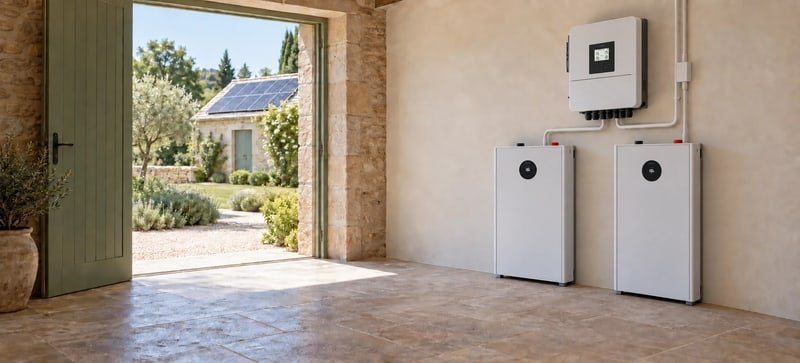
Battery storage
Physical battery or virtual storage. A choice that suits your electricity use.
We help you compare the capacity, fees, terms and overall cost of the proposed options, in light of your electricity use.
Free discussion, no obligation.
Understand before you choose
Two options to compare
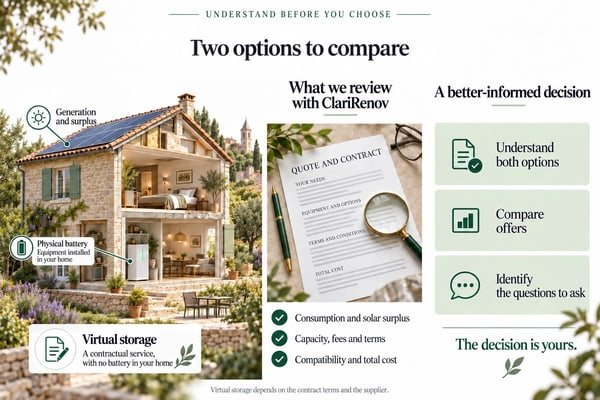
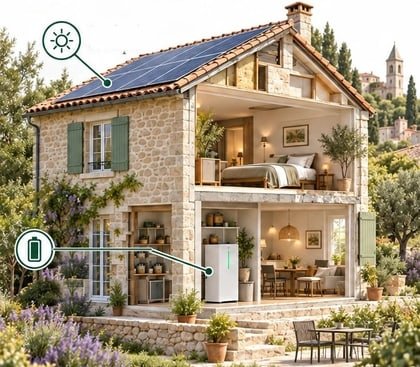
- Generation and surplus
- Physical batteryEquipment installed in your home
Virtual storageA contractual service, with no battery in your home
What we review with ClariRenov

- Consumption and solar surplus
- Capacity, fees and terms
- Compatibility and total cost
Virtual storage depends on the contract terms and the supplier.
Batteries and storage
The points to understand and the questions to ask
What we look at together on a storage proposal.
-
Capacity and power
Capacity (kWh) is how much energy can be stored, power (kW) how much the battery can deliver at any moment: both must match your evening and night-time usage.
Questions to ask
Ask the contractor
- Do the proposed capacity and power match my evening and night-time usage?
-
The economics
A battery is only useful if there is a surplus to store.
Details and questions to ask
Its cost comes on top of the panels and the payback is calculated over years, on assumptions you need to know.
Ask the contractor
- What share of my current or planned production is not used during the day?
- What assumptions are the promised savings based on?
-
Lifetime, compatibility and installation
Warranted cycles and remaining capacity at the end of the warranty, coupling and compatibility with the inverter, available space and room temperature.
Questions to ask
Ask the contractor
- What remaining capacity does the battery guarantee at the end of the warranty?
- Is it compatible with my existing inverter, or does it need replacing?
-
Functions promised and warranties
Backup during outages, smart control, monitoring app: we check what is actually included.
Details and questions to ask
Backup power is not automatic: it depends on the equipment and the installation.
Ask the contractor
- Does the battery work during a grid outage? Under what conditions?
- Which warranties cover the battery, and under what conditions is it replaced?
Virtual storage: the conditions to check in each contract
Before comparing several offers, check:
- the subscription, fees and overall cost over time;
- how the energy set aside is counted and how the credit can be used;
- any limits on quantity or validity periods for the credit;
- the conditions if you change electricity supplier;
- termination, and what happens to any remaining credit.
We go through these conditions with you in the contract you are offered.
To compare no storage, a home battery, virtual storage or both on a worked example: Home battery or virtual storage: what to do with your solar surplus?
How the support works
-
You describe your installation and your consumption habits, and send us the proposal.
-
We identify the assumptions and contract conditions to check, then prepare with you the questions to ask.
-
For a physical battery, if you wish, we request a quote for you from a partner contractor, subject to availability in your area, then check its proposal and present it to you.
Frequently asked questions
Your questions about batteries
Will a battery make me energy independent?
Rarely completely. In winter, solar production is lower and consumption often higher; most installations stay connected to the grid. A battery increases the share of your own energy you use, without necessarily eliminating electricity purchases.
Can a battery be added later?
Often, yes, provided the installation was designed for it or the chosen equipment allows it. It is a useful question to ask at the very first solar quote.
Do you also review quotes for a battery on its own?
Yes. Whether the battery is proposed with panels or separately, we look at it against the same criteria.
Explore our other services
-
Solar panels
Generation, self-consumption and equipment choices.
-

Heating and heat pumps
A solution suited to your home and your needs.
-

Air conditioning
Summer and winter comfort, capacity and positioning.
-

Windows, doors and insulation
Glazing, materials, insulation and installation quality.
Let's talk about your project.
Planning work? Already received a quote? Comparing several options? Tell us about your situation.