

The short answer
- A plug-and-play kit is 1 or 2 panels and a micro-inverter that you install yourself, on the ground or on a balcony.
- It saves little, but it can pay for itself. In our example in Gironde: about €70 to €180 a year, depending on how it is mounted and the number of panels.
- Only electricity used at the time counts. What the home does not use is neither paid for nor stored.
- Before plugging it in: a declaration to Enedis, which is mandatory, and a connection to have checked by an electrician. Since September 2025, the French electrical standard has prohibited connecting a panel to a standard socket outlet.
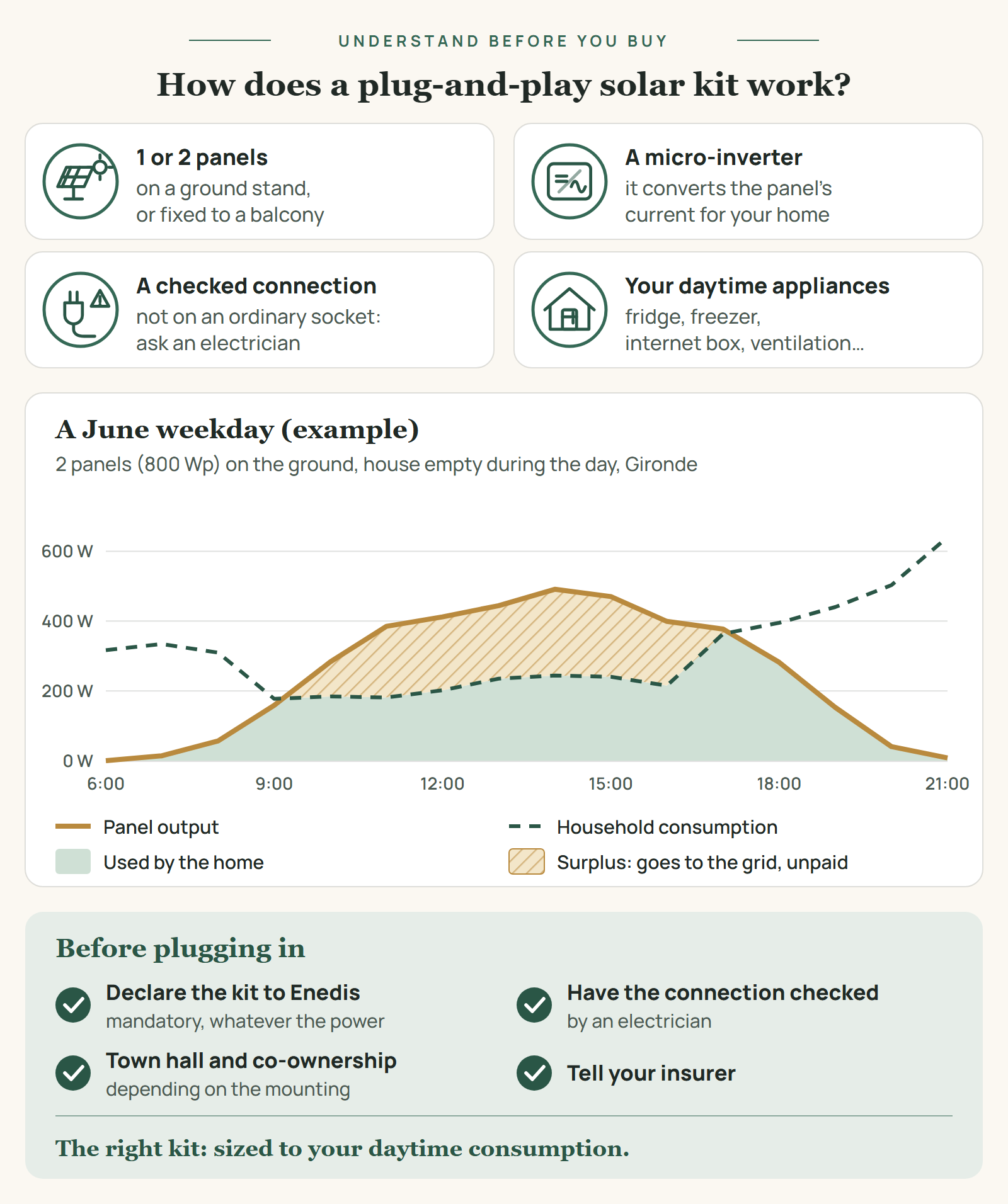
How does it work?
The panel produces current during the day. The micro-inverter converts it into current the home can use. The appliances running at that moment use it first: fridge, freezer, internet box, ventilation, devices on standby. You then buy less electricity: that is your saving.
In the evening and at night, the kit produces nothing. And when it produces more than the home uses, the rest is lost to you.
How much does it save?
Here is the yearly saving in our example: a house in Gironde, panels facing due south, calculated hour by hour with the model behind our solar simulator.
| Kit | Someone home during the day | House empty during the day on weekdays |
|---|---|---|
| 1 panel (400 Wp) on the ground, tilted at 30° | About €102 | About €97 |
| 2 panels (800 Wp) on the ground, tilted at 30° | About €178 | About €139 |
| 1 panel (400 Wp) on a balcony, vertical | About €71 | About €70 |
| 2 panels (800 Wp) on a balcony, vertical | About €137 | About €112 |
Price used: €0.2001 incl. VAT per kWh, regulated tariff on the Base option at 1 August 2026. These amounts illustrate an example, they are not a promise: shade, orientation and your habits change the result.
What makes the difference:
- The mounting. Vertical, on a balcony, a panel produces about 30% less than tilted at 30° (PVGIS, Bordeaux).
- The second panel saves less than the first. When the house is empty, it often uses less than 250 W during the day. With 2 panels on the ground, nearly a third of the output is then lost.
- The size of the home. In a flat that is empty during the day, 2 panels on a balcony save only about €87 a year: nearly 40% of their output is lost.
How long does the kit take to pay for itself? Divide what it costs you, electrician included, by the yearly saving.
Example: a 2-panel kit at €700, an amount chosen for the example. At about €139 a year (on the ground, house empty during the day), it pays for itself in about 5 years. At about €112 (on a balcony), in a little over 6 years.
See the calculation
The figures come from the model behind our simulator: hour-by-hour output (PVGIS), home consumption based on measurements in 100 homes (ADEME, RTE, Enertech), regulated price at 1 August 2026. Only electricity used at the time is counted: the surplus is neither paid for nor stored. Current prices are assumed to stay the same.
The house in the example: 3 people, 4,000 kWh a year, electric water heater at night, no electric heating.
- 1 panel on the ground: 508 kWh produced a year, 508 used with someone home during the day (€102), 483 if the house is empty during the day (€97).
- 2 panels on the ground: 1,017 kWh produced, 891 used (€178) or 695 (€139).
- 1 panel on a balcony: 354 kWh produced, 354 used (€71) or 350 (€70).
- 2 panels on a balcony: 709 kWh produced, 684 used (€137) or 558 (€112).
The flat: 2 people, 2,000 kWh a year, no electric water heater or electric heating, empty during the day on weekdays. 2 panels on a balcony: 709 kWh produced, 435 used, i.e. €87 a year.
Sample calculation: 695 kWh × €0.2001 = €139.07, i.e. about €139.
The calculation is done hour by hour. In reality, consumption varies from minute to minute: the share used on site may be a little lower.
Before plugging in: the steps
1. Declare the kit to Enedis
- It is mandatory, even if you send nothing to the grid, and whatever the power. The declaration is made online, on the Enedis Connect portal (in French).
- A document to attach: a Consuel certificate or a sworn statement. Enedis says an exemption is possible for plug & play equipment that is already assembled and compliant with standard NF EN 50549-1-4.
- An agreement to accept (the CACSI): you undertake not to send electricity to the grid.
- A Linky meter is mandatory. If you do not have one yet, it will be installed.
What if the kit produces more than the home uses? The surplus goes to the grid, unpaid, unless an "anti-injection" device or a "zero injection" setting prevents it. As you have undertaken not to inject, choose a kit sized to your daytime consumption, or equipment that blocks injection.
2. Have the connection checked by an electrician
In an answer published on 26 May 2026, the French Government pointed to a rule in the electrical installation standard NF C 15-100, published in August 2024 and in force since September 2025: connecting a generator, such as a solar panel, to a standard socket outlet is prohibited. It cites two risks: electric shock from touching live metal parts, and overheating of the wiring, which can cause a fire without the protective devices detecting it.
In practice: before plugging in the kit, ask an electrician how to connect it in your home. Add that cost to the price of the kit.
3. Town hall, co-ownership, landlord
- On the ground: according to Service-public, panels under 3 kW and no more than 1.80 m high need no formality outside protected areas. In a protected area, for example near a historic monument, you need a prior declaration (déclaration préalable) at the town hall.
- On a balcony or a wall: the kit changes how the building looks. Ask the town hall before fixing it.
- In a co-owned building: ask the managing agent (syndic) first. The balcony is part of the façade, and the agreement of the general meeting may be required.
- Tenant: talk to your landlord before fixing anything.
4. Tell your insurer
The study by the French National Consumer Institute (INC) and ADEME advises declaring the kit to your home insurer. Check that it is covered, for example in case of fire or if the panel falls.
Choosing a kit
- The power. Base it on your home's daytime base load: what the appliances that run all the time use. In your Enedis customer account, you can see your consumption hour by hour (you sometimes have to switch this option on). According to Photovoltaique.info, beyond two panels, daytime consumption is rarely enough.
- The micro-inverter. Enedis requires an inverter compliant with standard NF EN 50549-1. Ask the seller for the certificate of compliance.
- Safety. In a test of 10 kits published by the French National Consumer Institute and ADEME, 2 kits failed the test checking that electrical connections cannot be touched without a tool. And one kit's measured power was almost 15% below the stated power.
- The mounting. It must be solid and withstand the wind, especially on a balcony. Never put a kit on a roof yourself: risk of falling and of leaks.
- The warranty. How long it lasts, for the panel and for the micro-inverter, and a seller you can reach if it breaks down.
- The total price. The kit, its stand and the electrician.
Already have panels that sell their surplus? According to Photovoltaique.info, a kit is not compatible: the buyer of your surplus cannot tell whether the electricity comes from the kit.
When a proper installation is the better choice
- Your home uses a lot of electricity during the day: working from home, a heat pump, a pool, an electric car. One or two panels will cover only a small part of it.
- You want to sell your surplus. A kit declared without injection sells nothing. See also Home battery or virtual storage: what to do with your solar surplus?
- You want panels on the roof. They must be installed by a professional. Before signing, read 7 things to check before signing a solar quote in France.
Frequently asked questions
Can you plug a solar panel into an ordinary socket in France?
Not into a standard socket outlet. In an answer published on 26 May 2026, the French Government pointed out that the electrical installation standard NF C 15-100, in force since September 2025, prohibits connecting a generator to a standard socket outlet, because of the risks of electric shock and fire. Ask an electrician how to connect the kit in your home.
Do you have to declare a plug-and-play solar kit in France?
Yes. According to Enedis, the declaration is mandatory, even if nothing is sent to the grid and whatever the power. It is done online, on the Enedis Connect portal. You accept an agreement in which you undertake not to send electricity to the grid, and a Linky meter is mandatory.
How much does a plug-and-play solar panel save?
In our hour-by-hour worked example in Gironde, a 400 Wp panel saves about €70 a year fixed vertically on a balcony, and about €100 on the ground, tilted at 30°. Two panels save about €110 to €180 a year, depending on how they are mounted and whether someone is home during the day. Electricity price used: Base option at 1 August 2026.
Can you sell the electricity from a plug-and-play kit?
No, not with a full self-consumption declaration: you undertake not to send anything to the grid. The kit is there to buy less electricity. Selling a surplus takes a different procedure with Enedis and a purchase contract, as for a rooftop installation.
Do you need planning permission for a solar kit in France?
It depends on how it is mounted. According to Service-public, ground-mounted panels under 3 kW and no more than 1.80 m high need no formality outside protected areas. Fixed to a balcony or a wall, the kit changes how the building looks: ask the town hall. In a co-owned building, ask the managing agent first.
Rules checked on 21 November 2026 against the sources below.